DAILY BEST KNOWLEDGE

The Evolution of Human Language: How We Learned to Speak and Connect
Ever wondered how language actually began? Explore the fascinating journey of the evolution of human language, from early grunts to modern complex communication. This guide breaks down the science behind how we learned to speak, think, and connect as a society. A deep dive into the origins of human expression.
HISTORY
Iftikhar Ishaque Memon
1/6/20269 min read
Introduction
Language is one of the greatest talents humans possess. It allows us to talk to each other, to ideas, to learn, to do business, and to build communities. Language, but did not always have the complexity of today. It was just developing slowly over a very long period. In this article, we will examine the origins of human languages, how they evolved, and how we got the thousands of languages that are currently alive.
Think for a moment about the sounds we make and the words we write. Have you ever wondered what the very first word spoken by a human actually sounded like? The journey of language is a fascinating mystery that bridges the gap between our primitive ancestors and our modern, hyper-connected world. It wasn't just about naming objects; it was about survival, sharing stories, and expressing love or fear. As our brains grew and our societies became more complex, so did our voices. From simple grunts and hand signals to the poetic beauty of literature and the fast-paced world of digital texting, language remains the ultimate tool of our evolution. Exploring its origins is like looking into a mirror it reveals not just how we speak, but how we think and what makes us truly human.
1. What Is the Evolution of Human Languages?
When we say evolution of human language, we mean:
i. How language first appeared in humans (a very long time ago).
ii. How languages changed over time (sounds, words, grammar).
iii. How one language became many languages as people moved and separated.
iv. How some languages grow and others disappear.
Language evolution has two sides:
Biological side – how the human body and brain changed so that we could speak and understand complex language.
Cultural side – how people in groups created and changed languages across generations.
2. How Did Language Start? (Origin of Language)
No one knows the exact first day when language started. There are no audio or video records from that time. But scientists and linguists have some ideas.
2.1 Theories about the origin of language:
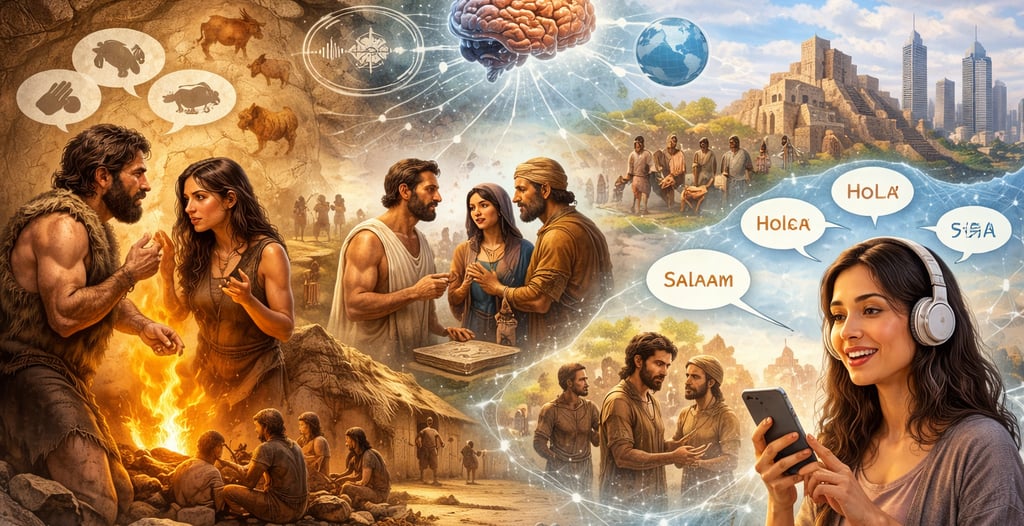
These theories highlight how human communication shifted from basic survival sounds and physical gestures to the complex spoken languages we use today. While the Gesture Theory emphasizes our physical evolution, theories like Bow-Wow focus on our connection with the natural world."
Bow‑Wow Theory
People started by copying sounds from nature, resembling animal noises, water, wind, etc.
Example: imitating a dog’s “bow‑wow” or a bird’s call.Pooh‑Pooh Theory
Language grew from natural cries of emotion like “ouch!”, “wow!”, “oh!”, which later became more structured.Gesture Theory
Before speaking, humans used hand movements and body language to communicate. Later, speech developed to support or replace gestures.Ding‑Dong Theory
The idea that there is a natural connection between sounds and meanings, so humans discovered certain “fitting” sounds for objects and ideas.
Scientists do not fully agree on any one theory. Most believe that language did not appear suddenly. It developed slowly from simpler communication systems (gestures, sounds and signs) into full speech.
· For a more scientific overview, you can read this article by the Linguistic Society of America.
3. When Did Humans Start Using Language?
Many scientists think:
Modern humans (Homo sapiens) looked approximately 200,000–300,000 years ago.
Completely established language may have appeared between 50,000 and 200,000 years ago.
Why do they consider this?
Cave paintings, jewelry, carvings, and ritual objects were found that display symbolic thinking.
Symbolic thinking is related to language, because both require abstract thoughts.
Therefore, the origin of language is frequently linked with the time when humans began to produce symbols and art.
4. How One Language Became Many languages
Imagine a small crowd of early humans who all spoke in a related way.
i. Some people moved to other places (migration).
ii. Groups became separated by mountains, seas, forests, or distance.
iii. Each group changed the way they spoke, little by little.
iv. After many generations, their way of speaking became different languages.
This is how language families were born.
4.1 Language families
A language family is a group of languages that came from one older language (called a proto‑language).
Examples:
Indo-European Family
Includes English, Urdu, Hindi, Bengali, Persian, Spanish, German, Russian, etc.Sino‑Tibetan Family
Includes Mandarin Chinese, Cantonese, Tibetan, Burmese.Afro-Asiatic Family
Includes Arabic, Hebrew, Amharic, Hausa.Niger‑Congo Family
Includes Swahili, Yoruba, Zulu, and many African languages.
Linguists compare words and grammar across languages to find these families and build family trees.
For an overview of language families and number of languages, see:
Ethnologue – How many languages are there?
5.The Recursion Factor: What Makes Human Language Unique?
While many animals communicate, human language is unique because of a property called "Recursion." This is the ability to place one idea inside another (e.g., "The man, who was wearing a hat, sat down").
The FOXP2 Gene Connection: Modern research points to a specific mutation in the FOXP2 gene that occurred roughly 100,000 years ago. This mutation didn't just give us the ability to speak; it rewired the human brain to control complex mouth movements and handle hierarchical grammar.
The Social Grooming Theory: Anthropologist Robin Dunbar suggests that language evolved as a form of "vocal grooming." As human groups became too large for physical grooming (like apes), speech allowed us to bond with multiple people at once, maintaining social harmony.
6. How Do Languages Change Over Time?
Languages never stay the same. Even your own language today is different from 200 years ago. There are a few main ways languages change:
6.1 Sound change
The way words are pronounced slowly shifts.
Old English word “knight” used to be pronounced something like “k‑nixt”.
Today we say “night” (without the “k” sound, and “gh” is silent).
Over centuries, many small sound changes can make old texts difficult to understand.
6.2 Vocabulary change
New things need new words:
Technology (internet, smartphone, email, AI).
Science (genes, atoms, climate change).
Culture (selfie, meme, vlog).
Languages also borrow words from each other.
English has borrowed many words from French, Latin, Arabic, Hindi, Urdu, and more.
6.3 Grammar change
Grammar is not fixed. For example:
Old English had many case endings on nouns (like Latin or German).
Modern English uses fewer endings and more word order and prepositions (to, from, with, in).
Sometimes grammar becomes simpler, sometimes more complex. It depends on the situation and history.
6.4 Language contact
When people speaking different languages meet (through trade, work, migration or colonization), they need to communicate. This can create:
Borrowed words (loanwords).
Mixed forms (code‑switching).
Pidgin languages (simplified languages used for trade).
Creole languages (when a pidgin becomes a native language of a community).
7. A Timeline of the Evolution of Human Languages
You can imagine this as an infographic timeline:
Before language
Early humans use gestures, facial expressions, and simple sounds.
Symbolic thinking (about 100,000–50,000 years ago)
Art, ornaments, and rituals appear.
Complex thinking and communication likely develop.
Fully developed spoken language
Humans use structured sentences, grammar, and larger vocabularies.
Stories, teaching, and planning become easier.
Proto‑languages and language families
One early language splits into different branches as people move.
Over thousands of years, we get many related languages.
Invention of writing (around 3200 BCE)
Sumerian cuneiform in Mesopotamia.
Egyptian hieroglyphs in Ancient Egypt.
Writing allows laws, stories, religious texts, and records to be kept.
Standardization
Governments and kingdoms choose one variety as the standard.
Used in schools, official documents, and literature.
Other dialects may be seen as “less correct” though they are also real languages.
Colonial period and global spread
European languages like English, Spanish, French, Portuguese spread worldwide.
Many indigenous languages become weaker or disappear.
Digital age (today)
Internet, phones, and social media change how we write and speak.
New slang, abbreviations, and styles appear every year.
Some languages gain power (like English), while others are at risk of dying.
8. Language Death and Endangered Languages
Sadly, many languages are disappearing.
8.1 Why do languages die?
A language may die when:
Children stop learning it and only use a more powerful language (for school, jobs, media).
People move to cities and use the majority language.
The language is looked down upon or banned in schools or government.
When the last native speaker dies, the language is extinct.
8.2 Why does it matter?
When a language dies, we lose:
Traditional stories and poems.
Knowledge about local plants, animals, and environment.
A unique way of seeing and describing the world.
8.3 Language revival
Some communities are trying to revive or strengthen their languages by:
Teaching them in schools.
Making TV, radio, and online content in the language.
Writing books, dictionaries, and grammar guides.
Encouraging parents to speak the language at home.
Examples of languages with revival efforts include Hebrew, Maori, Welsh, and many others.
9. Why is Studying Language Evolution Important?
Studying the evolution of human languages helps us:
Understand human history and migration.
See how cultures are connected or different.
Learn about human thinking and how the brain works.
Protect endangered languages and cultural diversity.
Improve language teaching, translation, and even artificial intelligence systems.
Linguistics (the science of language) uses:
Old texts and inscriptions.
Comparison of related languages.
Computer models and statistics.
Information from archaeology and genetics.
All of this helps build a clearer picture of how languages have changed over thousands of years.
Quick Timeline: The Milestones of Human Speech
To help our readers visualize the journey of communication, here is a professional summary of our linguistic evolution:
2 Million Years Ago: Early hominids likely used basic gestures and emotional calls (similar to modern primates).
500,000 Years Ago: The physical development of the 'Hyoid bone' in the throat suggests that ancestors like Neanderthals could produce some speech-like sounds.
100,000 Years Ago: The emergence of "Proto-Language"—using simple words without complex grammar (similar to a toddler’s speech).
50,000 Years Ago: The "Great Leap Forward." Language became fully symbolic, allowing humans to create art, myths, and complex plans.
Modern Language Evolution: From Cave Paintings to Emojis
While the core theories of language take us back thousands of years, the evolution of how we communicate hasn't stopped. In fact, we are living through one of the fastest shifts in language history right now. Here is how ancient theories connect to our modern digital lives:
The Return of Visual Language (Emojis): Interestingly, we are moving back toward the Gesture Theory. Instead of typing long sentences, we now use emojis (like 😊,or 🙏) to express complex emotions. Much like our ancestors used hand signals or cave drawings, we are once again using visual symbols to bridge language barriers across the globe.
Internet Slang and 'Mixing': Language evolution today happens on social media. Terms like LOL, Ghosting, or DM show how quickly new "dialects" appear. This is a modern example of Language Splitting and Mixing, where the internet creates a shared global vocabulary that everyone understands, regardless of their native tongue.
Artificial Intelligence (AI) and Voice: With tools like Siri, Alexa, and AI chatbots, we are evolving into a "Voice-First" era. We are now training machines to understand the nuances of human speech. This brings us back to the Ding-Dong and Bow-Wow theories, as we focus on the natural resonance and sounds that make communication effective between humans and technology.
Global English and Hybrid Languages: Because of global connection, we see the rise of hybrid languages like Hinglish or Spanglish. This proves that language is a living, breathing entity that adapts to its environment to survive just as it did thousands of years ago.
Conclusion
In the end, the evolution of human language is much more than just a historical timeline; it is a beautiful, ongoing story of human connection. From the very first gestures and primitive sounds to the complex digital world of emojis and AI-driven speech, language has always been the heartbeat of our civilization.
It is a living thing that continues to appear, change, split, mix, and grow. While some ancient languages have faded into silence, new ways of speaking and texting are emerging every day, reflecting our changing minds and societies. Language is, in many ways, a mirror—it shows us where we came from and gives us a glimpse of where we are going. As we look to the future, the story of communication remains unwritten, waiting for us to add new words, new styles, and new ways to understand one another. Every time we speak, write, or text, we are participating in a journey that began thousands of years ago.
FAQ:
Q1. How many languages exist in the world today?
Researchers estimate there are about 7,000 languages in the world. However, many of them have very few speakers and are in danger of disappearing in the next 100–200 years.
Q2. What is the oldest written language?
The earliest known writing system is Sumerian cuneiform, from around 3200 BCE in Mesopotamia. Another very old system is Egyptian hieroglyphs. We know these languages because people carved or wrote them on clay tablets, stone, and other materials.
Q3. Why do languages keep changing?
Languages change because people change. New inventions, social changes, contact with other cultures, and even fashion in speaking affect language. No language is completely fixed; if people use it, it will slowly change.
Q4. Can a dead language come back to life?
Yes, sometimes. The best example is Hebrew, which stopped being a spoken everyday language for many centuries but was revived and is now the main language in Israel. Other languages, like Welsh and Maori, are not fully dead but are being strongly revived through education and media.
Q5. How does the internet affect language?
The internet makes language change faster. New words, emojis, abbreviations, and memes spread quickly. People often mix languages online. At the same time, the internet can help protect small languages by allowing communities to create content in their own language.
Linguistic Research & Professional Note
Daily Best Knowledge provides this content based on current archaeological, genetic, and linguistic studies. Please keep in mind:
Theoretical Nature: Since spoken language leaves no fossils, many theories about its exact origin are based on logical inference and modern biological evidence.
Educational Purpose: This article is meant for academic and general interest. For specialized research, we recommend consulting peer-reviewed journals in evolutionary linguistics.
Ongoing Evolution: Language is not a finished product; it continues to evolve today through technology, internet slang, and global cultural exchange.
"The development of complex language was the foundation for organized society. To understand how these early cultures thrived, read our detailed guide on the 7 Ancient Civilizations That Changed the World.
Want to keep a summary of these fascinating theories for your studies or future reading? Download our comprehensive PDF guide on the Evolution of Human Language and its modern impacts
© 2025. All rights reserved.
This platform delivers well-researched articles to empower your personal and professional life.