DAILY BEST KNOWLEDGE

Top 5 Muslim Scientists and Their Discoveries
Discover the top 5 Muslim scientists and their discoveries that shaped modern science, from medicine and optics to algebra and chemistry, with FAQs and key points.
HISTORY
Iftikhar Ishaque Memon
1/7/20266 min read
Introduction:
Muslim scientists contributed greatly to the foundation of modern science. Scholars from the Muslim world deposited ancient knowledge, incorporated it themselves, and passed this information along to Europe and the rest of the world during the Golden Age of Islam. But many of these names are unrecognizable to the public. In this article, we will learn about the 5 greatest Muslim scientists and their discoveries and how their ideas still influence medicine, physics, astronomy and mathematics today.
Description:
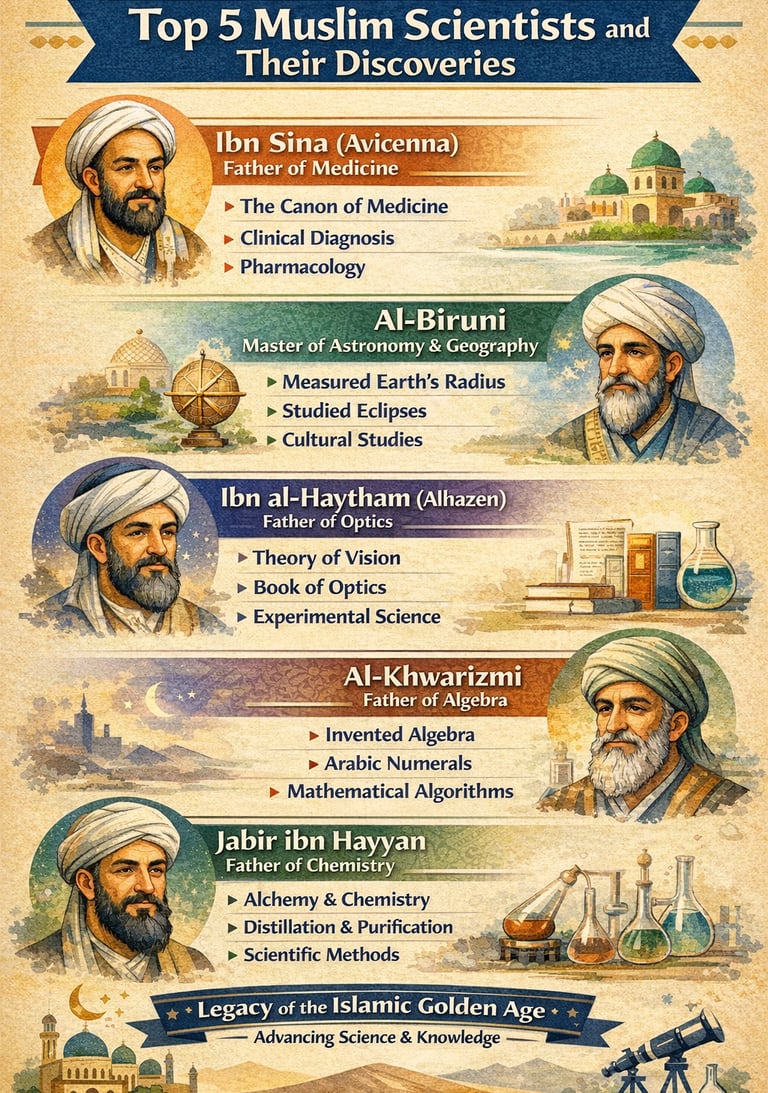
1. Ibn Sina (Avicenna) – The Father of Early Modern Medicine:
Who Was Ibn Sina?
Ibn Sina (980–1037), known in the West as Avicenna, was a Persian polymath who made major contributions to medicine, philosophy, and science. He wrote hundreds of books, but his most famous work is “The Canon of Medicine”, which became the standard medical textbook in Europe and the Muslim world for centuries.
Key Discoveries and Contributions:
Systematic Medical Encyclopedia
The Canon of Medicine organized all medical knowledge of his time in a clear, logical way.
It discussed anatomy, diagnosis, treatment, and pharmacology, making medicine more scientific and less superstitious.
Clinical Observation and Diagnosis
Emphasized careful observation of patients before treatment.
Described diseases like diabetes and discussed how sweet-tasting urine is a sign of it.
Differentiated between contagious diseases and non-contagious conditions.
Pharmacology and Experimental Methods
Wrote about testing medicines carefully and observing their effects.
Introduced rules for determining if a drug really works.
Why Ibn Sina Matters Today?
Modern clinical practice, medical textbooks, and evidence-based medicine can trace some of their roots back to Ibn Sina’s systematic approach. His work helped shift medicine from tradition to scientific methodology.
For more on Ibn Sina’s medical influence, you can read a summary on the U.S. National Library of Medicine:
Ibn Sina and the Canon of Medicine
2. Al‑Biruni – Master of Astronomy, Geography, and Physics:
Who Was Al‑Biruni?
Abu Rayhan al‑Biruni (973–1048) was one of the most brilliant scientists of the Islamic Golden Age. He worked in astronomy, mathematics, physics, geography, and comparative religion. He is often called a pioneer of the scientific method because of his focus on precise measurements and experiments.
Key Discoveries and Contributions:
Accurate Measurement of the Earth’s Radius
Al‑Biruni developed a trigonometric method to calculate the Earth’s radius using a mountain’s height and the horizon angle.
His result was surprisingly close to modern values, showing his advanced understanding of geometry and observation.
Astronomy and Earth’s Rotation
Suggested the possibility that the Earth might rotate on its axis, centuries before this became widely accepted.
Made detailed observations of solar and lunar eclipses, planetary positions, and timekeeping.
Geography and Cultures
Wrote about India’s geography, religions, and sciences with an objective and respectful approach.
His book “Tahqiq ma li-l-Hind” is considered a masterpiece of comparative cultural study.
Why Al‑Biruni Matters Today?
Al‑Biruni showed how precise measurement, mathematics, and open-minded observation can work together. His methods resemble the modern scientific method used in physics and astronomy today.
3. Ibn Al‑Haytham (Alhazen) – The Father of Optics:
Who Was Ibn al‑Haytham?
Ibn al‑Haytham (965–1040), also known as Alhazen, was an Iraqi scientist who made revolutionary contributions to optics, physics, and mathematics. He is often called the “father of modern optics” and one of the earliest true experimental scientists.
Key Discoveries and Contributions:
Correct Theory of Vision
Before Ibn al‑Haytham, many believed that eyes emit rays to see objects.
He proved that light enters the eye from external sources, explaining vision correctly for the first time.
The Book of Optics (Kitab al‑Manazir):
A seven-volume work covering reflection, refraction, lenses, mirrors, and perception.
Described how light travels in straight lines and how we see images in mirrors.
Experimental Method
Insisted on testing theories with experiments, not just relying on logic or philosophy.
Used dark rooms (camera obscura), lenses, and controlled experiments to study light.
Why Ibn al‑Haytham Matters Today?
His work laid the foundation for modern optics, which is essential for glasses, cameras, telescopes, microscopes, and many technologies. His experimental approach also influenced the development of modern scientific methods.
You can find an overview of Ibn al‑Haytham’s optical work at https://pmc.ncbi.nlm.nih.gov/articles/PMC6074172/
4. Al‑Khwarizmi – The Father of Algebra:
Who Was Al‑Khwarizmi?
Muhammad ibn Musa al‑Khwarizmi (c. 780–850) was a Persian mathematician and astronomer. His work in algebra, arithmetic, and algorithms changed mathematics forever. “Algorithm” comes from the Latinized form of his name, and “algebra” is from the title of one of his books.
Key Discoveries and Contributions:
Foundations of Algebra
Wrote “ Kitab fi al-Jabr wa al-Muqabala” ( The elongated Book on computation by Completion and Balancing).
Totally explained how to solve linear and quadratic equations.
Introduced algebra as an independent branch of mathematics, not just geometry.
Arabic Numerals and Calculation
Helped spread the use of the Hindu‑Arabic numeral system (0–9) in the Islamic world.
This system later reached Europe and replaced Roman numerals, making calculations far easier.
Astronomy and Geography
Worked on astronomical tables and helped improve geographic coordinates of major cities.
Contributed to more accurate maps and navigation.
Why Al‑Khwarizmi Matters Today?
Modern mathematics, computer science, and even programming algorithms build on the algebraic methods and numerical systems that al‑Khwarizmi helped systematize. Any time you solve an equation or write an algorithm, you are using ideas he helped formalize.
5. Jabir ibn Hayyan (Geber) – Pioneer of Chemistry:
Who Was Jabir ibn Hayyan?
Jabir ibn Hayyan (c. 721–c. 815), known in Latin as Geber, is often called the “father of early chemistry” (or historically, alchemy). He worked in chemistry, alchemy, medicine, and philosophy, and introduced many experimental techniques and laboratory tools.
Key Discoveries and Contributions:
Laboratory Techniques
Developed and improved key chemical processes such as distillation, crystallization, sublimation, and filtration.
Used equipment similar to modern retorts and stills, allowing more controlled experiments.
Mineral and Acid Studies
Studied substances like acids, salts, and metals.
Early work laid the groundwork for identifying and preparing substances such as sulfuric and nitric acids in later centuries.
Experimental Approach to Matter
Focused on practical experimentation, testing how substances change under heat, mixing, and other conditions.
Organized materials and reactions systematically, a step towards modern chemistry.
Why Jabir ibn Hayyan Matters Today?
Modern chemical laboratories still use methods like distillation and crystallization, which were refined by Jabir. His combination of theory and practical experimentation helped transform alchemy into something closer to modern chemistry.
A general overview of Jabir’s influence can be found in the Encyclopaedia Britannica:
Jabir ibn Hayyan
Key Points:
Overview of the Top 5 Muslim Scientists
Ibn Sina (Avicenna) – Built a complete medical system, wrote The Canon of Medicine, promoted clinical observation and evidence-based treatment.
Al‑Biruni – Measured the Earth’s radius with high accuracy, advanced astronomy and geography, used precise mathematical methods.
Ibn al‑Haytham – Correctly explained how vision works, wrote The Book of Optics, and used controlled experiments to study light.
Al‑Khwarizmi – Founded algebra, helped spread Arabic numerals, and influenced modern algorithms and mathematics.
Jabir ibn Hayyan – Developed laboratory techniques (distillation, crystallization), studied acids and minerals, and paved the way for modern chemistry.
Conclusion:
The contributions of these five Muslim scientists show that the history of science is truly global. From medicine and optics to algebra and chemistry, their work helped shape the world we live in today. By understanding their discoveries, we not only honor their legacy but also gain a deeper appreciation of how knowledge progresses across cultures and centuries. Whether you are a student, teacher, or history enthusiast, learning about these scholars can inspire you to explore science with the same curiosity and dedication they showed.
FAQs about Muslim Scientists and Their Discoveries:
1. Why are Muslim scientists important in the history of science?
Muslim scientists are important because they preserved, translated, and expanded earlier Greek, Indian, and Persian knowledge. They added their own original discoveries in fields like medicine, mathematics, astronomy, and chemistry, which later influenced European scientists and the development of modern science.
2. What time period is called the Islamic Golden Age?
The Islamic Golden Age is usually considered to be from the 8th to the 14th century. During this time, many Muslim scholars worked in Baghdad, Cordoba, Cairo, and other centers, producing groundbreaking work in science, philosophy, and literature.
3. How can students today learn more about Muslim scientists?
Students can read reliable history of science books, check academic articles and encyclopedias, and explore online courses from universities. It is important to use authentic sources rather than random blogs to avoid myths and exaggerated claims.
4. How did Muslim scientists preserve and translate ancient knowledge?
During the Islamic Golden Age, scholars translated Greek, Persian, and Indian texts into Arabic in famous centers like the House of Wisdom in Baghdad. They did not just translate; they also corrected, expanded, and commented on this knowledge. This preserved important scientific works and later helped Europe rediscover classical science.
5. What is the role of Muslim scientists in mathematics?
Muslim mathematicians like Al‑Khwarizmi formalized algebra, improved geometry, and helped spread the Hindu‑Arabic numeral system (0–9). He worked on trigonometry, developed new methods for solving equations, and introduced more systematic ways of doing calculations. These ideas are still used in schools, engineering, and computer science today.
6. How can I use this information about Muslim scientists in my studies or projects?
You can use this information to create school projects, presentations, research papers, or blog articles about the history of science. Teachers can also use these scientists as examples to show how different cultures contributed to modern knowledge. Adding dates, key works, and real discoveries makes your project more accurate and informative.
© 2025. All rights reserved.
This platform delivers well-researched articles to empower your personal and professional life.