
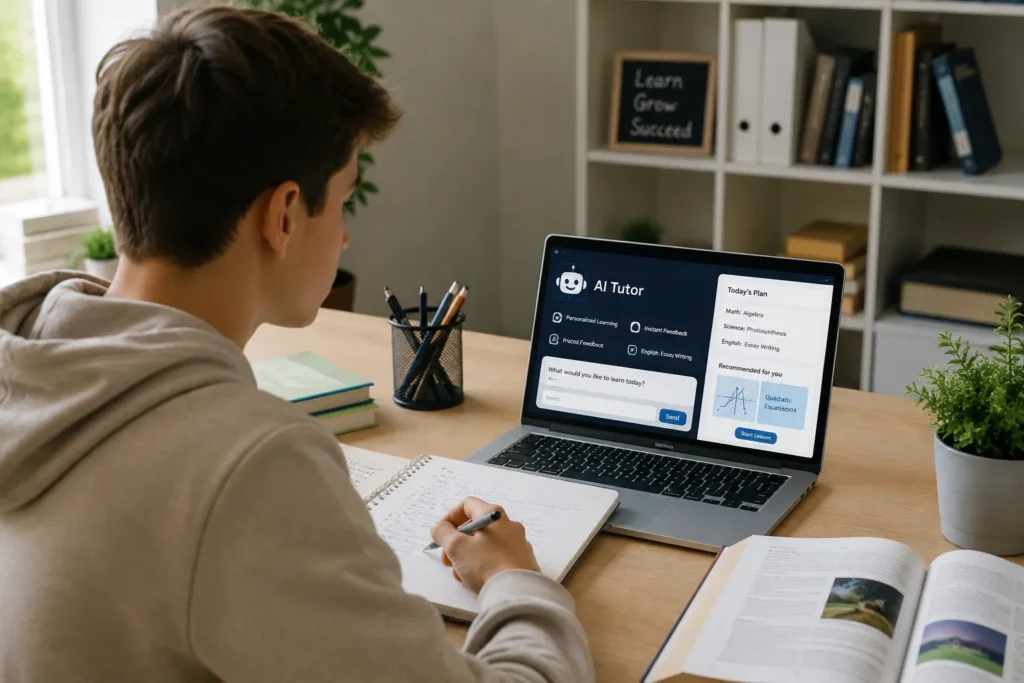
The Future of Learning: How AI is Reshaping Education
Quick Overview
- Artificial Intelligence (AI) is transforming classrooms and study habits around the world.
- Today’s students and teachers are increasingly using AI tools for tasks such as research, writing, and solving practice problems.
- These tools promise personalized learning through tailored lessons and pacing, faster feedback, and assistance with administrative tasks like grading and lesson planning.
- Early results are promising, with one study showing that students who use an AI tutor scored significantly higher than their peers in traditional classroom settings.
- However, experts caution that simply providing answers is not enough; AI must be utilized with clear teaching goals to effectively boost learning.
- Equity and ethics remain major concerns, especially as many schools continue to lack reliable internet access or necessary devices.
- If not carefully designed, AI could inadvertently widen existing educational gaps or provide opportunities for students to cheat.
- In short, AI offers exciting new tools for personalizing education, automating tedious tasks, and expanding access, but only if it is well-managed and keeps learners, rather than algorithms, at the center.
Introduction:
Imagine a classroom where every student gets a custom tutor available 24/7 or where teachers spend less time on paperwork and more time with kids. That vision is becoming reality thanks to AI. Artificial intelligence—from chatbots like ChatGPT to specialized tutoring apps—is now embedded in many education tools. The adoption of AI in classrooms has accelerated significantly; according to recent findings, 85% of teachers and 86% of students utilized AI tools during the 2025-26 school year.”
Teachers report saving hours each week on lesson planning and grading. School systems use AI to generate test questions, grade assignments, and even help design curriculum. As one UNESCO expert notes, AI is “being used for a variety of purposes: for ideation, for writing, for programming, and much more.“ These new tools are available to nearly anyone online, making powerful educational resources (like a tutor or personalized lessons) possible outside elite schools or districts.
As we navigate the shifting landscape of classrooms, it is clear that we are witnessing a significant transformation in how knowledge is accessed and taught. For a deeper dive into these ongoing changes, you can read more about how AI is reshaping education.
💡 Quick Recommendation: If you want to understand how artificial intelligence is transforming modern learning, classrooms, and everyday work, Ethan Mollick’s “Co-Intelligence: Living and Working with AI” is the ultimate guide to read.
How AI is Evolving in Schools:
Two key trends stand out. First, generative AI—tools that can write text or solve problems on demand—is booming. ChatGPT and similar chatbots can answer questions or draft essays and are now used by millions of students and educators. Unlike older tech (like canned software), generative AI is easy to use and often free.
Second, intelligent tutoring systems are maturing. Platforms like Khan Academy’s Khanmigo use AI to ask guiding questions (rather than just giving answers). Adaptive learning apps (such as DreamBox Math or Carnegie Learning) adjust their lessons in real time to fit each student’s level. Even virtual labs and simulations powered by AI (e.g., Labster) let students safely run experiments at home or school. On the administrative side, tools like Gradescope and Turnitin use AI to speed up grading and check for plagiarism, giving teachers back valuable time.
AI Educational Tools: A Quick Comparison
| Tool | Primary Function | Best For | Pros | Cons |
|---|---|---|---|---|
| ChatGPT | Content & Idea Gen | All Users | Highly versatile | May contain bias |
| Khanmigo | AI Tutoring | K-12 Students | Deep learning | Requires internet |
| Gradescope | Automated Grading | Teachers | Massive time saver | Needs human review |
| Duolingo Max | Language Learning | Language Students | Real-time feedback | Paid features only |
| DreamBox/Carnegie | Adaptive Math | Math Students | Instant difficulty adjust | Needs teacher oversight |
| Labster/PraxiLabs | Virtual Science Labs | Science Students | Safe & engaging | Requires VR/PC |
To see how AI can act as a supportive tutor rather than a shortcut, students can explore tools like Khanmigo, which focuses on asking guiding questions to help you learn.
As AI tools become integrated into modern classrooms, educators and students need practical strategies to adapt rather than resist. If your goal is to understand how to use AI ethically and effectively for teaching and learning, you can check out the comprehensive guide “Teaching with AI: A Practical Guide to a New Era of Human Learning.”
Benefits of AI in Learning:

When used thoughtfully, AI can bring big benefits. The biggest is personalization: AI can adapt lessons on-the-fly to a student’s pace and style. For example, in an AI-powered tutoring trial, students using the AI tutor scored significantly higher on tests than those in ordinary classes. One report finds AI-driven tutoring can boost learning three-fold compared to traditional instruction. Personalized paths also boost engagement – AI courses have shown up to 60% higher engagement and 57% faster mastery than traditional methods. Students can learn when and where they need to, at their own speed.
Another benefit is efficiency for teachers. AI can handle routine work like grading quizzes or drafting a lesson outline, saving teachers about 5–6 hours a week on average. Freed from paperwork, teachers spend more time on interactive teaching. AI can also help identify which students are struggling on which topics (through data analytics), so teachers can intervene early.
AI tools can also make education more accessible. Students in remote or under-resourced areas can access high-quality content and tutoring online. For example, UNESCO notes AI could help “address current inequalities regarding access to knowledge” if applied equitably. Translation and text-to-speech AI can help learners with disabilities or who speak different languages. In special education, AI was reported to reduce Individualized Education Program (IEP) preparation time by 90%, speeding support for students with learning needs.
Summary: How AI Impacts Learning
| Impact Area | Description | Potential Benefits |
|---|---|---|
| Personalization | Customizes lessons to a student’s pace. | Boosts motivation (74–75% reports). |
| Assessment | Automated grading & instant feedback. | 10x faster feedback; identifies learning gaps. |
| Accessibility | Supports diverse learning needs. | Bridges knowledge gaps via translation/bots. |
| Teacher Workload | Automates admin & lesson planning. | Saves 5–6 hours/week for creative teaching. |
| Curriculum Design | Creates & aligns content at scale. | Keeps resources updated and relevant. |
| Engagement | Uses interactive games/chatbots. | Drives up to 10x more class engagement. |
Challenges and Concerns:
The flip side is that AI brings new risks. A top concern is academic integrity. Many teachers worry students might use AI to cheat. Indeed, 72% of teachers surveyed said AI can let students pass off work as their own. Without clear policies and tools, schools face plagiarism and falsified assignments. Relatedly, bias and equity are issues. AI systems trained on biased data can inadvertently favor some groups of students or send the wrong signals. For example, if an algorithm grades more harshly on certain phrasing, it could disadvantage non-native speakers or creative thinkers. UNESCO warns that most countries still lack AI regulations, so issues like data privacy and algorithmic fairness are unprotected.
Another challenge is the digital divide. Not all students have fast internet or devices. UNESCO reports only 40–50% of primary and lower-secondary schools worldwide have reliable internet. If AI tools require high-tech setups, they risk leaving behind students in poorer or rural schools. Training is also a hurdle: one study noted 45% of educators had little to no training on AI tools, so they can’t use them effectively. Finally, there’s the worry that AI might undermine deeper learning: if students rely on AI for answers, they may not develop critical thinking. Indeed, 90% of faculty fear overreliance on AI will harm students’ critical skills.
Real-World Success Stories:
Around the world, innovators are showing how to use AI well. For example, Khan Academy’s Khanmigo tutor uses AI to ask guiding questions, helping students think through problems (rather than giving them answers). Teachers there say it can generate a week’s worth of lesson plans in minutes, giving them more time to teach. In higher education, Arizona State University launched an AI innovation challenge in 2024 that sparked hundreds of projects (many focused on using AI to support student success). Some U.S. school districts are using adaptive math programs that adjust in real time to each child’s needs, dramatically improving test scores over a term.
On the policy side, UNESCO and OECD are pushing for smart guidelines. UNESCO’s global guidance emphasizes a human-centered approach: tech should serve educators and learners, not replace them. OECD likewise cautions that AI should be used with clear teaching principles, or else students just get better answers without deeper learning. Both stress teacher training and equity. Some governments (like Singapore and Canada) are already funding teacher AI training programs and revising curricula to include AI literacy.
The Changing Role of Teachers in an AI-Driven World:
Teachers will need new skills: not just how to use AI tools but how to integrate them into lessons. The good news is AI can become a partner, taking care of drudgery so teachers focus on mentoring and critical thinking. According to UNESCO, AI can “amplify teachers’ capacity” when co-designed with educators. Students will need guidance on using AI responsibly, understanding its limitations and learning to fact-check. AI literacy (understanding how these tools work) is becoming a basic skill for today’s learners. Policies must keep pace: experts suggest clear rules on privacy, data, and even the age-appropriateness of AI tools. Governments should also invest in infrastructure (devices, connectivity) so every student can benefit.
How Students Can Start Using AI Responsibly
AI is a powerful assistant, but it works best when it supports your brain rather than replacing it. Think of AI tools like ChatGPT or tutors as brainstorming partners or study coaches; they can help you understand tough concepts, outline your essays, or explain complex math problems in simpler terms. However, always aim to do the heavy lifting yourself. If you use AI to get instant answers without trying to solve the problem first, you lose the chance to build your own critical thinking skills, which are essential for your future success.
The golden rule for using AI is to treat it as a starting point, not the finish line. Always double-check the information you receive, as AI can sometimes make mistakes or sound confident while being wrong. Once you get an idea or a draft from AI, try to rewrite it in your own words, add your own perspective, and verify the facts through your textbooks or trusted class materials. By staying in the driver’s seat and using AI as a tool for guidance rather than a shortcut, you will become a more effective and smarter learner.
To begin your journey with AI effectively, you don’t need expensive subscriptions. There are many powerful resources available; you can check out our curated list of 10 Free AI Tools for Students in 2026 to get started with the right tech.
Prefer reading offline? Click below to download this full article for free
FAQs:
Q: Will AI replace teachers?
A: No. AI is a tool, not a teacher. It excels at giving immediate feedback or personalized drills, but nothing replaces a human teacher’s guidance, encouragement, and judgment. Most experts agree AI should augment teachers, not replace them. Teachers will remain crucial for interpreting AI results, teaching social skills, and ensuring students are learning deeply.
Q: Are students learning less because they rely on AI?
A: It depends on how it’s used. Simply getting answers from AI is not learning. But many studies find that when used properly (with teacher oversight and thought-provoking tasks), AI can actually improve learning outcomes. The key is to use AI for guidance, practice, and creativity and keep students actively thinking.
Q: Is AI in education fair and safe?
A: Fairness and safety are active concerns. AI can reflect biases in its training data, so educators must watch for uneven treatment. Privacy is another issue: AI tools collect student data, so schools need strong safeguards. UNESCO’s guidance stresses a “human-centered, ethical and inclusive” approach. In practice, this means vetting tools for bias, teaching digital citizenship, and having rules for data use.
Q: Do students like using AI tools?
A: Many students enjoy AI-powered learning because it feels interactive and personalized. Surveys suggest a majority of students feel AI has supported their learning – for example, 80% of students said AI helped their studies. Features like instant feedback and chatbots (as virtual tutors) keep learners engaged. Still, attitudes vary: younger students may use AI more for games and fun, while older students use it for writing help or research.
Q: What should teachers do next?
A: Teachers can start by experimenting with AI tools in low-stakes ways: try an AI tutor for math drills, or use an AI chat tool to brainstorm essay ideas. It is also important to set clear rules (e.g., when it is okay to use AI) and teach students responsible use. Professional development on AI is becoming widely available; for instance, UNESCO and many universities now offer courses on “AI in education.” The goal is to become comfortable with AI’s strengths and limitations.
Conclusion:
As a content writer, I initially felt a sense of hesitation toward AI, fearing it might eventually dim the spark of human creativity. However, the reality has been quite the opposite. Rather than replacing my voice, AI has acted as a digital partner that handles the tedious administrative heavy lifting, allowing me to focus on what truly matters: storytelling and connection. It doesn’t do the thinking for me; instead, it clears the clutter, letting me spend more energy on crafting content that actually resonates with my readers.
What I have learned is that the true power of these tools lies in how we frame our relationship with them. If we treat AI as a shortcut, we limit our own potential; but if we treat it as an assistant, we unlock new levels of productivity. By delegating the repetitive aspects of my work to AI, I’ve found more time to focus on the nuance, empathy, and critical thought that only a human can provide. It’s not about letting the machine take the lead, but rather about using technology to amplify the value we bring to our audience.
AI is undeniably reshaping education, making it more personalized and efficient. When schools use AI thoughtfully, it can help students learn faster, engage more, and overcome challenges like large class sizes or scarce resources. At the same time, we must navigate pitfalls: ensuring equal access, protecting academic integrity, and keeping learning human-centered. As one UNESCO report on AI for the future of learning emphasizes, we need to “shift the conversation to include AI’s role in addressing inequalities” and ensure everyone can benefit.
The future classroom will likely combine human teachers and smart tools, where technology handles the routine and teachers focus on inspiration. By guiding this change with clear policies and training, educators and policymakers can harness AI’s promise while safeguarding the essence of learning.
Recommended Books:
(1) Name of the Book: “Co-Intelligence: Living and Working with AI“
(by Ethan Mollick)
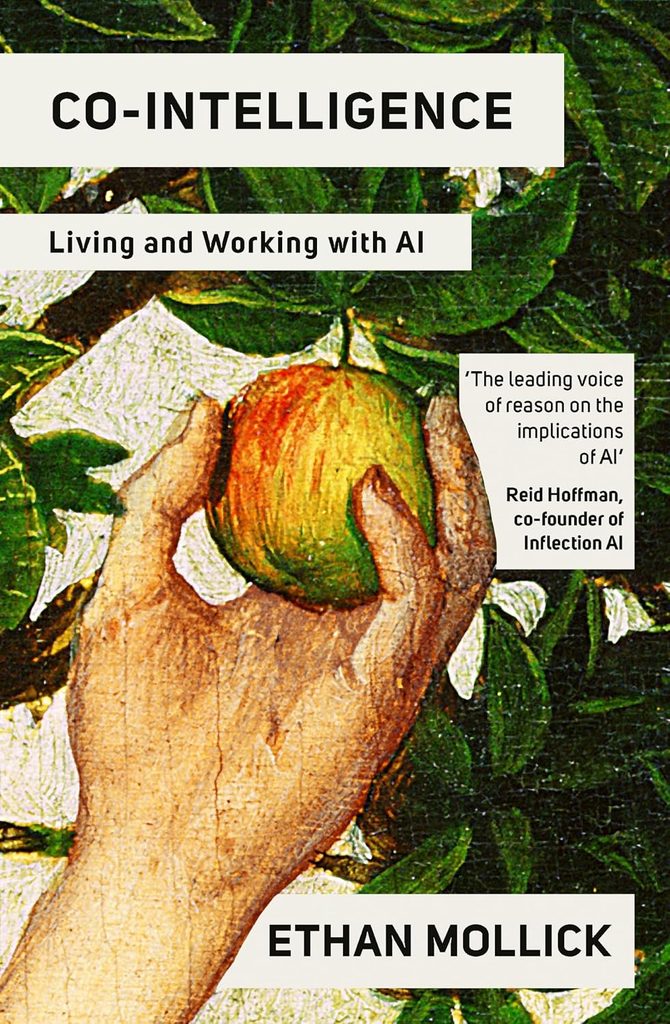
Overview of the Book:
AN INSTANT NEW YORK TIMES BESTSELLER
From Wharton professor and author of the popular One Useful Thing Substack newsletter Ethan Mollick comes the definitive playbook for working, learning, and living in the new age of AI
Something new entered our world in November 2022—the first general-purpose AI that could pass for a human and do the kinds of creative, innovative work that only humans could do previously. Wharton professor Ethan Mollick immediately understood what ChatGPT meant: after millions of years on our own, humans had developed a kind of co-intelligence that could augment, or even replace, human thinking. Through his writing, speaking, and teaching, Mollick has become one of the most prominent and provocative explainers of AI, focusing on the practical aspects of how these new tools for thought can transform our world.
In Co-Intelligence, Mollick urges us to engage with AI as a co-worker, co-teacher, and coach. He assesses its profound impact on business and education, using dozens of real-time examples of AI in action. Co-Intelligence shows what it means to think and work together with smart machines and why it’s imperative that we master that skill.
Mollick challenges us to utilize AI’s enormous power without losing our identity, to learn from it without being misled, and to harness its gifts to create a better human future. Wide-ranging, hugely thought-provoking, optimistic, and lucid, Co-Intelligence reveals the promise and power of this new era.
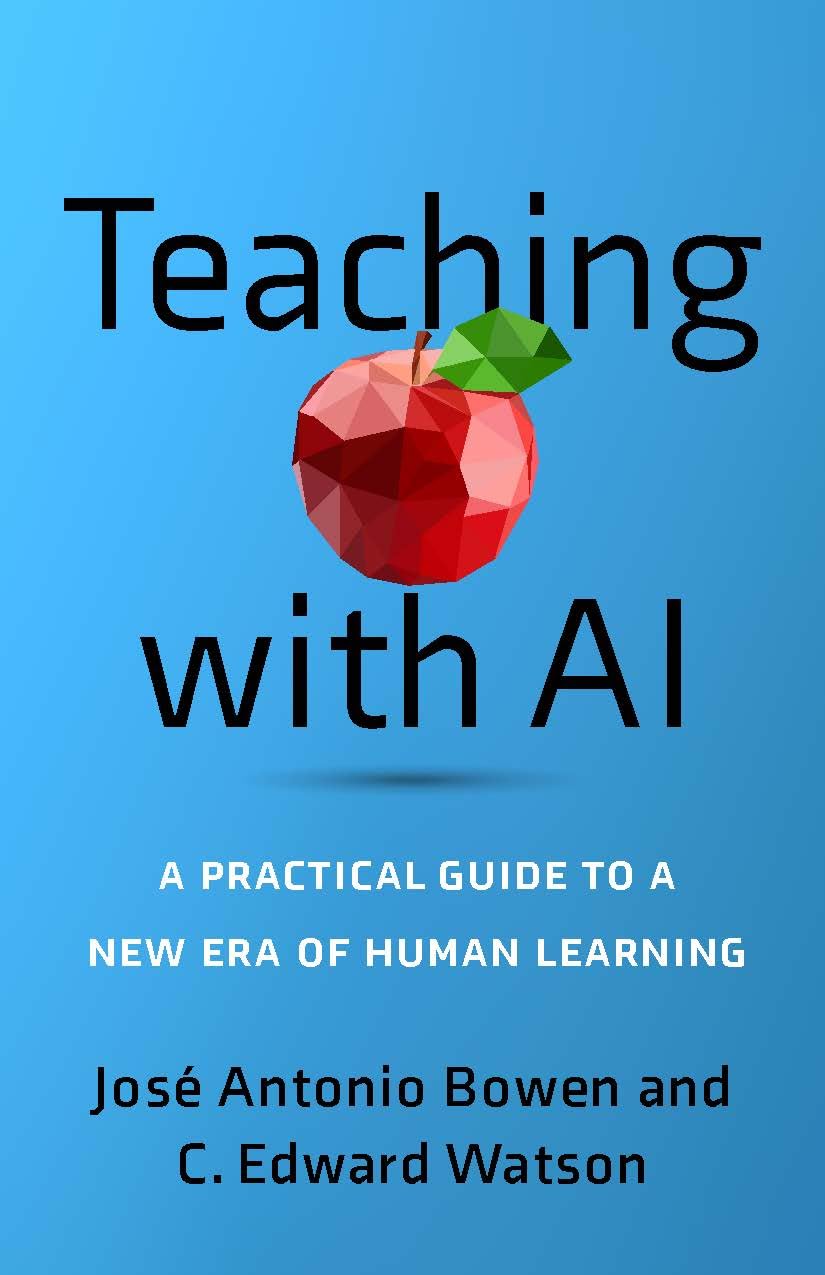
(2) Name of the Book: “Teaching with AI: A Practical Guide to a New Era of Human Learning” (by Jose Antonio Bowen and C. Edward Watson)
Overview of the Book:
In this groundbreaking and practical guide, teachers will discover how to harness and manage AI as a powerful teaching tool. Jose Antonio Bowen and C. Edward Watson present emerging and powerful research on the seismic changes AI is already creating in schools and the workplace, providing invaluable insights into what AI can accomplish in the classroom and beyond.
By learning how to use new AI tools and resources, educators will gain the confidence to navigate the challenges and seize the opportunities presented by AI. From interactive learning techniques to advanced assignment and assessment strategies, this comprehensive guide offers practical suggestions for integrating AI effectively into teaching and learning environments. Bowen and Watson tackle crucial questions related to academic integrity, cheating, and other emerging issues.
In the age of AI, critical thinking skills, information literacy, and a liberal arts education are more important than ever. As AI continues to reshape the nature of work and human thinking, educators can equip students with the skills they need to thrive in a rapidly evolving world. This book serves as a compass, guiding educators through the uncharted territory of AI-powered education and the future of teaching and learning.
(3) Name of the Book: “AI 2041: Ten Visions for Our Future” (by Kai-Fu Lee)
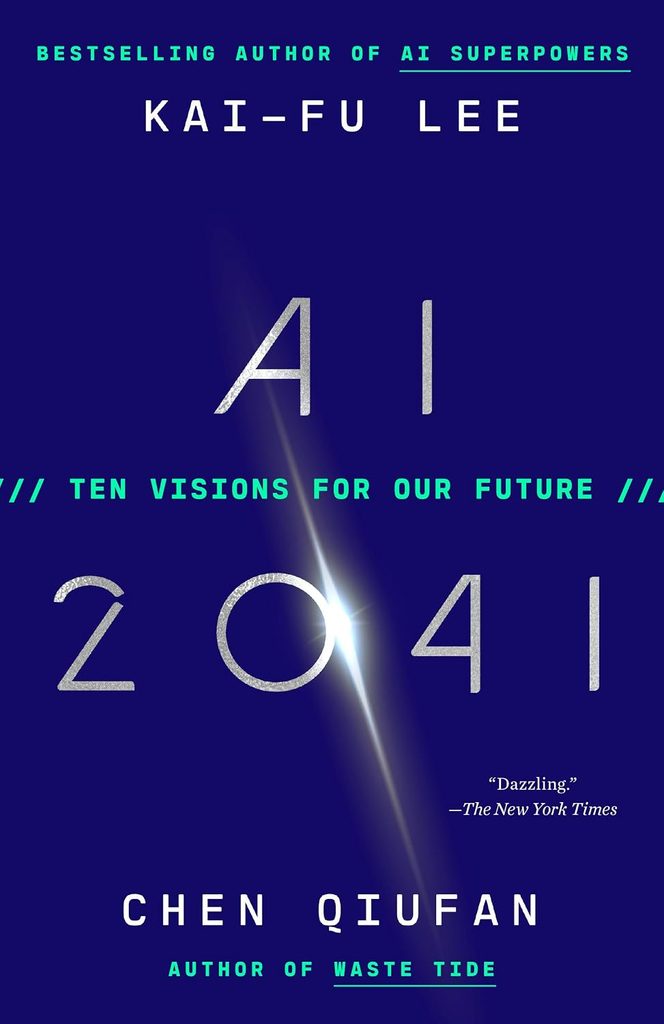
Overview of the Book:
How will AI change our world within twenty years? A pioneering technologist and acclaimed writer team up for a “dazzling” (The New York Times) look at the future that “brims with intriguing insights” (Financial Times).
A BEST BOOK OF THE YEAR: The Wall Street Journal, The Washington Post, Financial Times
Long before the advent of ChatGPT, Kai-Fu Lee and Chen Qiufan understood the enormous potential of artificial intelligence to transform our daily lives. But even as the world wakes up to the power of AI, many of us still fail to grasp the big picture. Chatbots and large language models are only the beginning.
In this “inspired collaboration” (The Wall Street Journal), Lee and Chen join forces to imagine our world in 2041 and how it will be shaped by AI. In ten gripping, globe-spanning short stories and accompanying commentary, their book introduces readers to an array of eye-opening settings and characters grappling with the new abundance and potential harms of AI technologies like deep learning, mixed reality, robotics, artificial general intelligence, and autonomous weapons.